
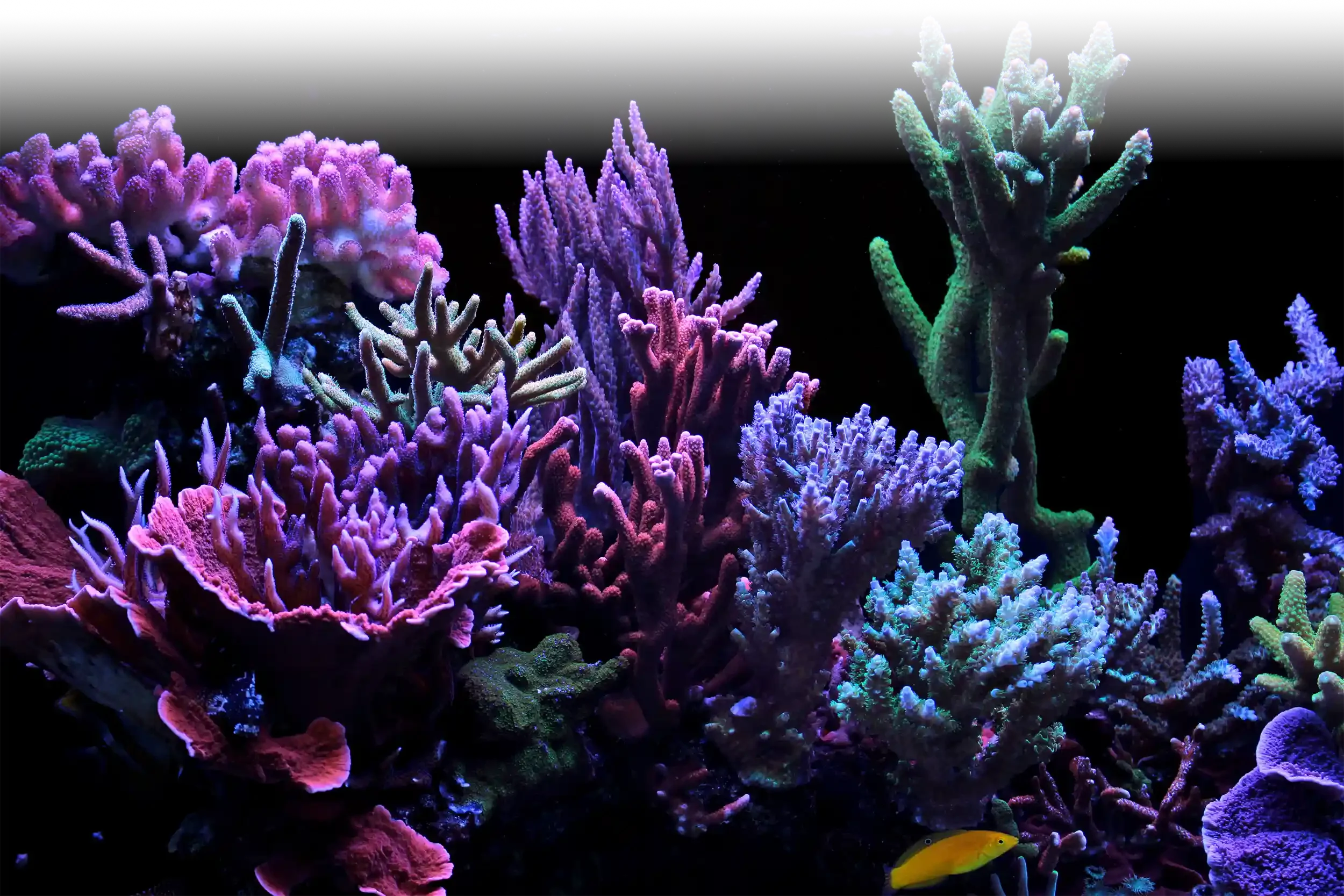
Start a Reef Tank
This guide will help you understand how to start a reef tank, choose the right equipment, cycle the aquarium, establish a healthy biome, and add fish and corals without creating unnecessary complexity.
-
90/10 Method
MISSION: Get that first reef tank win under your belt!
The 90/10 Method is your step-by-step guide to Achieving 90% of the results the pros get with just 10% of the research, effort, mistakes, and cost.
This isn't just a guide telling you what to do. We actually build and follow two reef tanks using this exact method, sharing the successes, inevitable speed bumps, and how to handle challenges in real time because seeing is believing.
-
SR150 Guide To Reefing
MISSION: Push the limits of what's possible and trailblaze modern reefkeeping.
We put equipment, technology, and reefkeeping methods to the test, challenge conventional wisdom, implement it on a live tank, and share our findings unfiltered.
If learning is the hobby, and it's not really a hobby unless you're getting better at it every week, the SR150 aims to be the last reefkeeping guide you'll ever need.
-
Reef Tank FAQ
MISSION: Answer the most common questions about starting a reef tank in 60 seconds or less.
Clear, straightforward answers without the endless searching, conflicting advice, or unnecessary complexity. Less confusion, more confidence, and a faster path to your first successful reef tank.
Start a Reef Tank: Beginner Reef Tank Setup Guide
Starting a reef tank can feel complicated, but the fundamentals are surprisingly straightforward when you focus on the things that matter most.
A successful reef aquarium needs stable saltwater, appropriate lighting, water movement, biological filtration, temperature control, and a healthy population of fish, corals, and microorganisms. The challenge is not buying every piece of equipment available. It is building a simple system where each component has a clear purpose.
What Is a Reef Tank?
A reef tank is a saltwater aquarium designed to support corals and other marine life in addition to fish.
Unlike a fish-only saltwater aquarium, a reef tank must provide the conditions corals need to survive and grow, including appropriate:
Salinity
Temperature
Alkalinity
Calcium
Magnesium
Nitrate and phosphate
Lighting
Water flow
Biological stability
The goal is to recreate the important functions of a natural reef environment in a manageable home aquarium.
Is a Reef Tank Hard to Maintain?
A reef tank does not have to be difficult, but unnecessary complexity can make it much harder.
The easiest reef tanks are generally built around:
Stable water parameters
Reasonable stocking levels
Reliable equipment
Consistent maintenance
Appropriate lighting and flow
A mature biological community
Simple methods that are easy to repeat
Success usually comes from doing the basics consistently rather than constantly changing equipment, additives, or methods.
What Size Reef Tank Is Best for a Beginner?
Larger reef tanks are generally more stable because changes in temperature, salinity, nutrients, and chemistry happen more slowly.
Very small reef tanks can work, but they leave less room for error.
For many beginners, a moderate-size aquarium offers a good balance between stability, cost, and maintenance.
When choosing a tank size, consider:
Available space
Budget
Desired fish
Desired coral
Maintenance time
Equipment cost
Long-term goals
The best reef tank is one you can comfortably maintain for years.
What Equipment Do You Need to Start a Reef Tank?
The exact equipment depends on the aquarium, but most reef tanks need the same basic functions.
Aquarium
Choose a tank that fits your available space and livestock goals.
Heater
A reliable heater maintains a stable temperature.
Using a separate temperature controller or aquarium controller can add an additional layer of protection.
Water Movement
Powerheads or wavemakers create circulation throughout the aquarium.
Corals depend on water movement to exchange gases, receive nutrients, remove waste, and avoid stagnant areas.
Reef Tank Lighting
Corals contain photosynthetic organisms that rely on light.
The correct reef light should provide adequate:
PAR
Spectrum
Coverage
Spread
The goal is not simply maximum brightness. It is delivering appropriate light evenly across the corals.
Filtration
Reef tank filtration may include:
Biological filtration
Mechanical filtration
Protein skimming
Refugiums
Activated carbon
Filter socks
Filter rollers
UV sterilization
Not every reef tank needs every filtration method.
Choose filtration based on the specific problem you are trying to solve.
Return Pump
Aquariums with a sump require a return pump to move water back into the display tank.
Automatic Top-Off
An automatic top-off system replaces freshwater lost to evaporation and helps maintain stable salinity.
Testing Equipment
At minimum, reef keepers should be able to monitor important parameters such as:
Salinity
Temperature
Alkalinity
Nitrate
Phosphate
Calcium and magnesium become increasingly important as coral demand increases.
Do You Need a Sump?
No.
Successful reef tanks can be built with or without a sump.
A sump provides additional space for equipment and can make filtration, dosing, heating, and maintenance easier.
All-in-one reef tanks keep much of this equipment in filtration chambers built into the aquarium.
Neither design is automatically better.
Choose the system that best fits your space, budget, and maintenance preferences.
What Water Should You Use?
Most reef keepers use purified RO/DI water.
Tap water can contain varying levels of:
Chlorine or chloramine
Silicate
Nitrate
Phosphate
Metals
Other dissolved contaminants
RO/DI water gives the aquarist much greater control over what enters the reef tank.
Mix the purified water with a quality marine salt mix until it reaches the desired salinity.
Natural seawater is approximately 35 ppt, which is commonly used as a target for reef aquariums.
What Rock Should You Use?
Reef tanks may be started with:
Dry rock
Live rock
Artificial rock
A combination of these options
Rock provides habitat for fish, surfaces for coral placement, and enormous amounts of area for bacteria and other organisms.
The choice between live and dry rock also has a major impact on how the biological community develops.
Dry rock offers control and fewer obvious hitchhikers.
Established live rock can introduce greater biological diversity much faster.
The tradeoff is that live material may also introduce organisms you did not intentionally add.
Should You Use Sand?
Sand is optional, but it can provide several benefits.
A sand bed can:
Provide habitat for microorganisms
Support sand-dwelling fish and invertebrates
Increase biological surface area
Create a more natural appearance
Bare-bottom reef tanks can also be highly successful and may be easier to keep free of accumulated detritus.
The right choice depends on the type of reef you want to build.
How Do You Cycle a Reef Tank?
Cycling establishes the biological processes needed to safely process waste.
Fish and other animals release ammonia.
Beneficial microorganisms convert ammonia into less toxic forms as part of the nitrogen cycle.
Traditionally, reef tank cycling focuses on establishing bacteria capable of processing ammonia.
Modern reef keeping also increasingly considers the larger biological community that develops on rock, sand, glass, and equipment.
A reef tank can process ammonia and still be biologically immature.
That distinction becomes important when dealing with early problems such as:
Dinoflagellates
Cyanobacteria
Diatoms
Hair algae
Other parts of the ugly phase
How Long Does a Reef Tank Take to Cycle?
There is no universal number of days.
The timeline depends on:
Starting material
Amount of biological inoculation
Temperature
Ammonia availability
Bacterial population
Rock and sand
How maturity is defined
A reef tank may become capable of processing ammonia relatively quickly while still requiring months to develop a mature and diverse biological community.
Do not confuse completing the nitrogen cycle with having a mature reef aquarium.
What Is the Reef Tank Ugly Phase?
New reef tanks commonly experience periods of:
Diatoms
Cyanobacteria
Dinoflagellates
Green algae
Other microbial growth
This is commonly called the ugly phase.
The aquarium contains open surfaces, available resources, and an immature biological community. Different organisms compete to colonize those surfaces.
The goal should not always be to eliminate every visible organism immediately.
In many cases, the more useful goal is to encourage a diverse, stable biological community that eventually occupies the available habitat.
When Can You Add Fish?
Fish should be added only after the aquarium can safely process the waste they produce.
Stock the tank gradually.
Adding too many fish too quickly can overwhelm a young system and create unnecessary nutrient and disease problems.
Also consider:
Adult fish size
Territorial behavior
Compatibility
Feeding requirements
Disease prevention
Long-term stocking plan
The order in which fish are introduced can matter just as much as the total number.
When Can You Add Corals?
Corals can often be added after the aquarium has become stable enough to support them, but there is no single universal timeline.
Before adding coral, make sure you understand:
Salinity
Temperature
Alkalinity
Nitrate
Phosphate
Lighting
Flow
Begin with hardy species that fit the environment you have created.
Do not select a coral first and then try to force the aquarium to meet its needs.
Build the environment, then choose livestock that fits it.
What Reef Tank Parameters Matter Most?
Important reef tank parameters commonly include:
Salinity
Approximately 35 ppt is a common target.
Temperature
Consistency is generally more important than chasing a precise decimal point.
Alkalinity
One of the most important parameters for stony coral growth.
Calcium
Used by corals and other calcifying organisms to build skeletons.
Magnesium
Helps support stable seawater chemistry.
Nitrate
An important source of nitrogen for reef organisms, but excessive levels can create problems.
Phosphate
An essential nutrient that can also contribute to unwanted growth when excessive.
pH
Influences many biological and chemical processes, including coral calcification.
The goal is not simply to hit one perfect number.
A successful reef tank depends heavily on reasonable values that remain stable over time.
How Much Light Does a Reef Tank Need?
Different corals require different amounts of light.
Very broadly:
Soft corals generally tolerate lower light
Many LPS corals prefer moderate light
SPS corals often require higher light
PAR meters allow reef keepers to measure usable light rather than guessing based on fixture wattage or visual brightness.
Light intensity is only part of the equation.
Coverage and spectrum matter too.
A coral receiving high PAR from one narrow direction may still experience significant shading.
How Much Flow Does a Reef Tank Need?
There is no single correct turnover number for every reef tank.
Flow depends on:
Tank dimensions
Aquascape
Coral type
Pump placement
Fish stocking
Desired detritus movement
Soft corals, LPS, and SPS may all respond differently to water movement.
The objective is generally to create broad, changing circulation throughout the aquarium without blasting coral tissue directly with a narrow stream of water.
How Often Should You Maintain a Reef Tank?
Most successful reef tanks rely on a repeatable maintenance routine.
Common tasks include:
Daily
Check temperature
Observe livestock
Check equipment
Feed fish
Weekly
Test important water parameters
Clean glass
Perform a water change if that is part of your method
Inspect filtration
Monthly or Periodically
Clean pumps
Service skimmers and filtration
Inspect plumbing
Calibrate equipment
Review dosing
Check heaters and safety systems
The best maintenance schedule is one simple enough that you will actually follow it.
Common Beginner Reef Tank Mistakes
Many early reef tank problems come from a small group of common mistakes:
Adding livestock too quickly
Constantly changing equipment or methods
Chasing perfect numbers
Excessive lighting
Inadequate water flow
Poor salinity control
Overfeeding
Buying livestock before researching its needs
Ignoring disease prevention
Overcomplicating filtration
Treating every visible organism as a problem
Failing to allow the aquarium time to mature
Patience remains one of the most useful tools in reef keeping.
A Simple Path to Starting a Reef Tank
A straightforward reef tank setup might look like this:
Choose the aquarium size and location.
Install heating, circulation, filtration, and lighting.
Fill the tank with properly mixed saltwater.
Add rock and substrate.
Establish the biological cycle and biome.
Verify stable salinity and temperature.
Begin testing important reef tank parameters.
Add fish gradually.
Introduce appropriate beginner corals.
Maintain a consistent routine and allow the system to mature.
You do not need to solve every future reef tank problem on day one.
Build a stable foundation first.
Learn More About Starting a Reef Tank
Explore these related Serious Reefs guides:
Reef Tank Equipment
Reef Tank Cycling
Reef Tank Biology and Biome
Reef Tank Chemistry
Reef Tank Parameters
Reef Tank Lighting
Reef Tank Flow
Reef Tank Filtration
Reef Tank Maintenance
Beginner Corals
Saltwater Fish Care
The Bottom Line
Starting a reef tank successfully is less about buying the most equipment and more about understanding the basic needs of the ecosystem.
Provide stable seawater, appropriate light, effective water movement, a healthy biological community, reasonable nutrient control, and consistent maintenance.
Then give the reef time to mature.
The best beginner reef tank is not necessarily the most advanced system.
It is the one that is simple enough to understand, stable enough to trust, and easy enough to maintain consistently.