The Ultimate Salt Test: Are We Choosing Reef Salt by Feelings or Data?
Choosing a salt mix for a reef tank often feels like a ritual: we use what our buddy uses, what the local shop stocks, or the brand with the flashiest packaging. That approach works a surprising amount of the time, but it leaves out something important — data. Ryan Thompson decided to take a step back from brand loyalty and anecdote and look at what’s actually inside the buckets we pour into our systems. Test results were shared in a popular thread on Reef2Reef. For more details on how Ryan Thompson performed his test, check out the Reef2Reef thread where he shared his approach and findings.
Disclaimer: This test was NOT performed by Serious Reefs. The video and summary below discusses the biggest outliers from Ryan’s exploration.
Note: Paid YouTube SR Members Using A Chrome Browser can watch videos natively above on Seriousreefs.com. Sign up HERE
SR videos are a community funded member only resource. Serious Reefs buys everything we review, accepts no sponsorships, and your memberships make it possible to keep every review truly unfiltered.
What Ryan Thompson Did and Why It Matters
He purchased multiple commercial reef salts anonymously, mixed them in identical 15-gallon batches, tested with hobby kits at home, and sent samples for professional ICP analysis. Tests were done independently without manufacturer involvement. The ATI lab chosen for primary reporting used ICP OES; ICP-MS was available (from a different company) but more expensive.
This approach gives two advantages: First, a broad scan shows which salts are close to natural seawater or the "expected" recipe. Second, it reveals outliers and buckets that fall well outside common ranges. Information like this can drive informed choices for our tanks.
How were salts tested and who paid for it?
Salts were purchased anonymously, mixed exactly as the labels instructed, and sent for ATI ICP-OES lab analysis. The testing cost about $1,500, was fully self-funded by Ryan Thompson, and conducted with no manufacturer involvement or sponsorship.
How He Approached The Testing
A few important methodological notes:
Blind purchasing reduces bias and simulates what most hobbyists actually buy.
ICP-OES was the primary method. It is solid for many elements but has limits at very low parts-per-billion and can differ from ICP-MS for some analytes. ICP-MS is more sensitive but more expensive.
Home kits were used for alkalinity, calcium and magnesium as a reality check. For some fast-changing parameters, hobby kits can be more useful than a single ICP snapshot.
Cost and scale: high-quality lab testing is not cheap. Comprehensive testing of many salts can run into the low thousands of dollars, which is why broad independent surveys like this are uncommon.
Key Findings and Takeaways By Parameter
Alkalinity
Most salts fell into a broad "safe" alkalinity range. We found a few notable deviations or surprise findings. One Red Sea Coral Pro bucket returned about 10 dKH from the lab while our home tests measured closer to 13 dKH. That discrepancy could be caused by precipitation in the sample vial during transit. Instant Ocean purple was higher than Reef Crystals. Brightwell NeoMarine produced a notably low reading around 6–7 dKH.
Practical takeaway: Test alkalinity with your hobby kit before use.

Ultimate Salt Test: Alkalinity
Calcium
Calcium varied significantly between salts. Tropic Marin Pro Reef showed values north of 500 ppm straight from the bucket in one case. Another supplier, HW Marine, was around 555 ppm. Brightwell was lower than expected. Other salts came in the expected 420–470 ppm range.
Practical takeaway: High-calcium buckets will skew your water-change dosing. If you rely on a predictable calcium input from water changes, test your salt first.
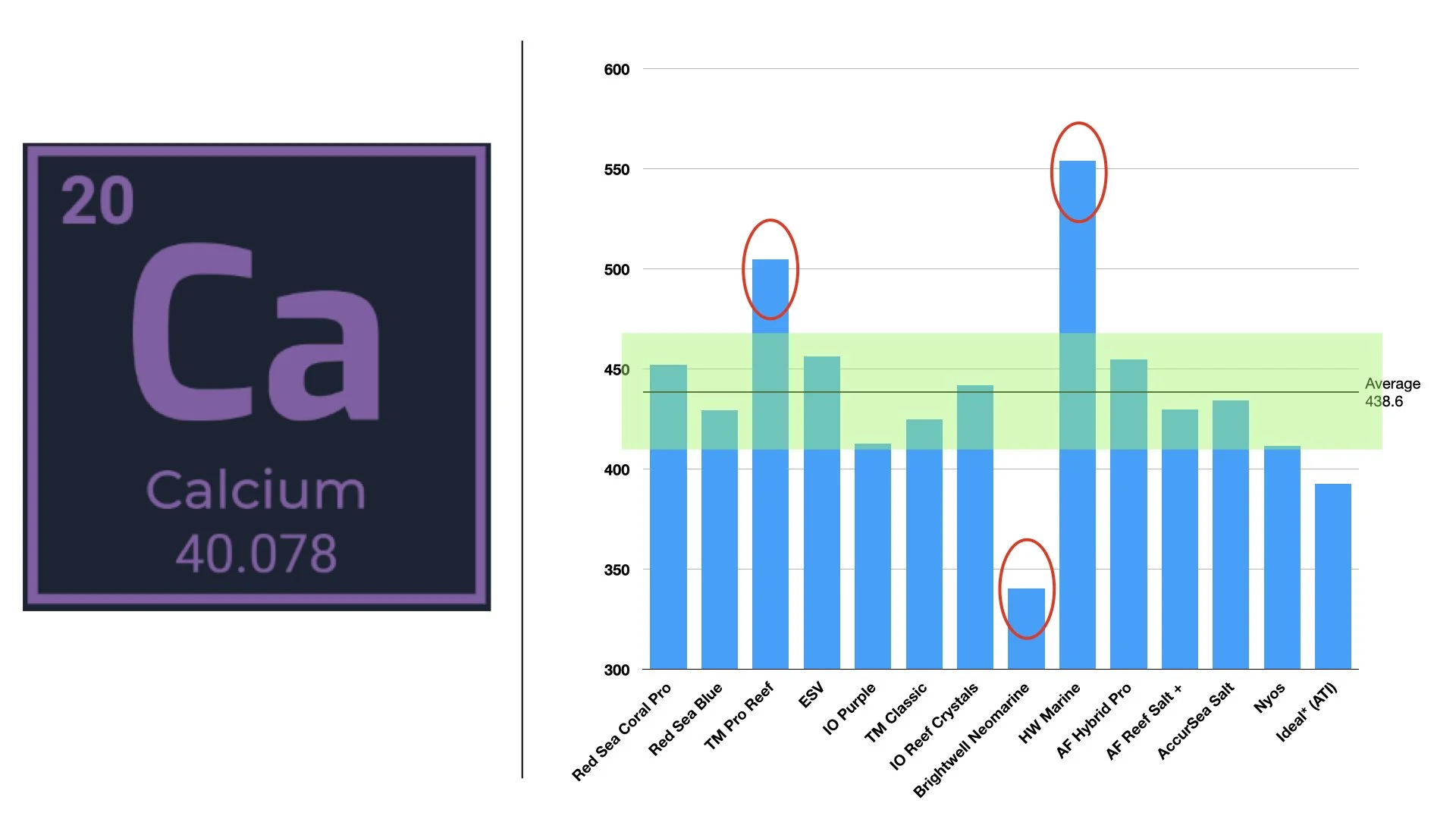
Ultimate Salt Test: Calcium
Magnesium
Magnesium results surprised us. Several salts measured well above typical ocean averages — into the 1,350 to 1,550 ppm range. This raised questions about ICP accuracy for magnesium.
Practical takeaway: treat magnesium readings with caution including with hobby-grade test kits.
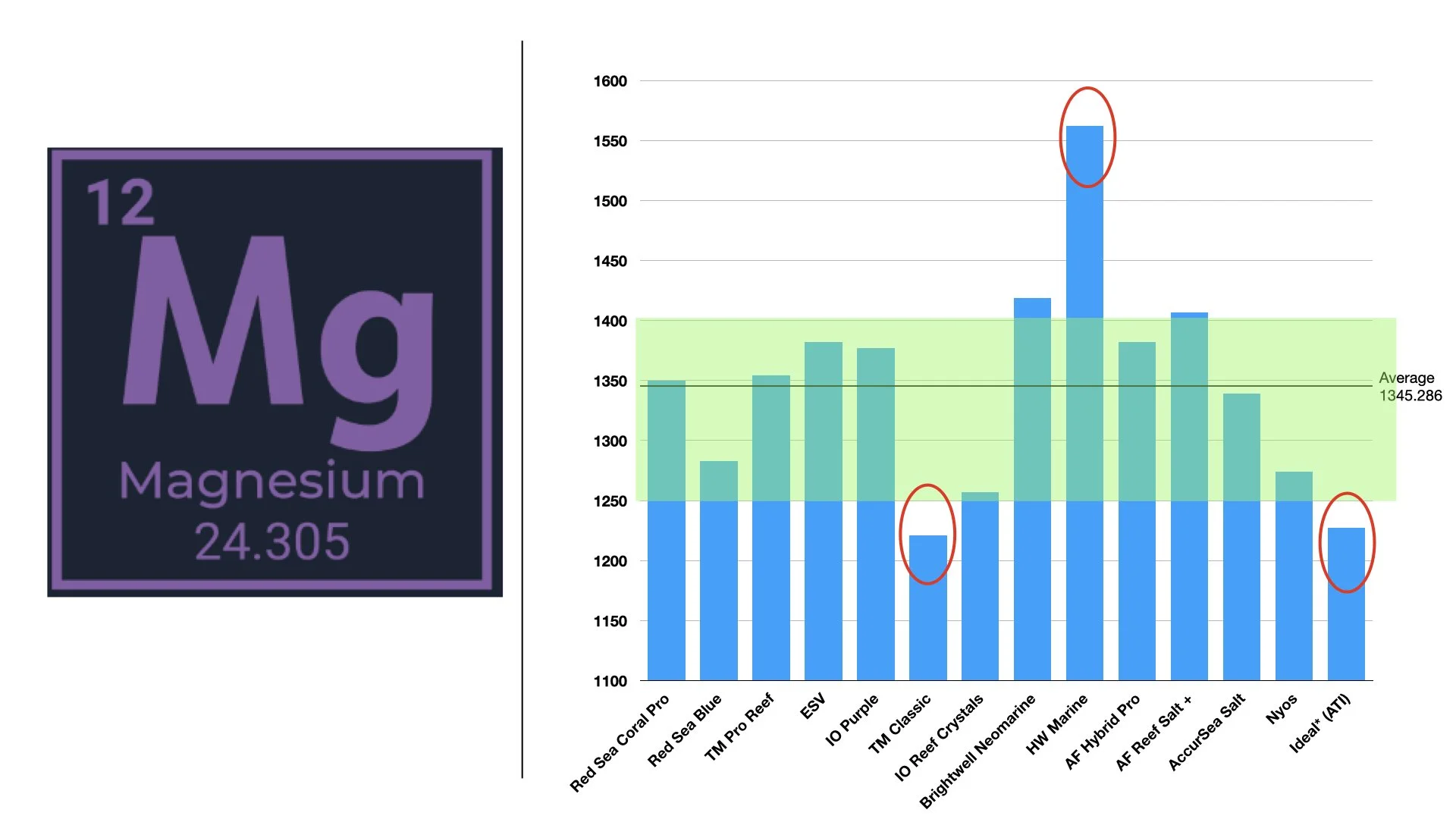
Ultimate Salt Test: Magnesium
Potassium and Bromine
Potassium varied by tens of ppm between buckets. Some salts produced noticeably higher potassium than others. Bromide also showed variance. These elements may affect coral coloration and chemistry subtly over time.
Practical takeaway: If you dose for trace elements or run sensitive corals, pick a salt with stable, repeatable potassium and bromide levels and test batches periodically.
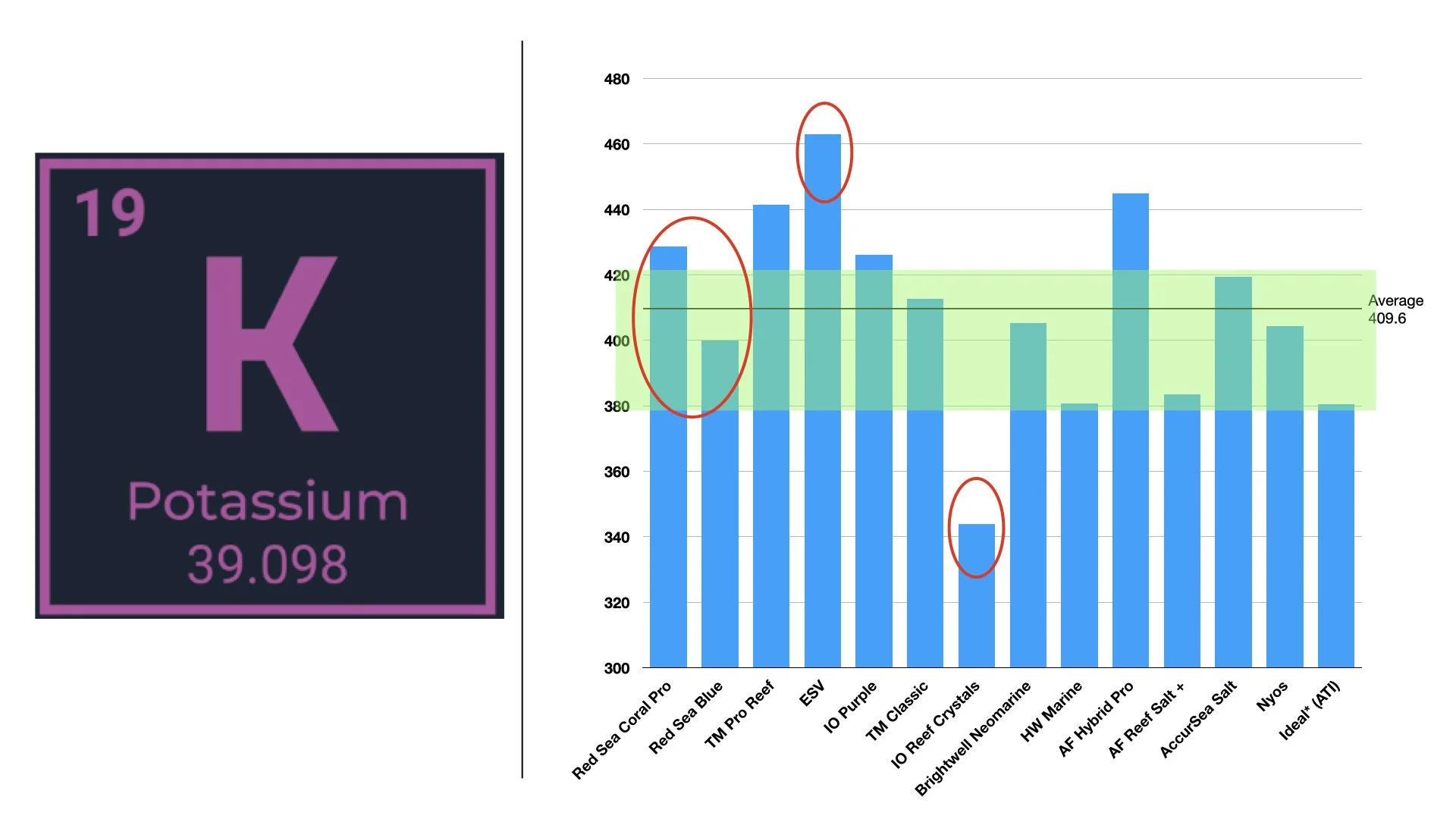
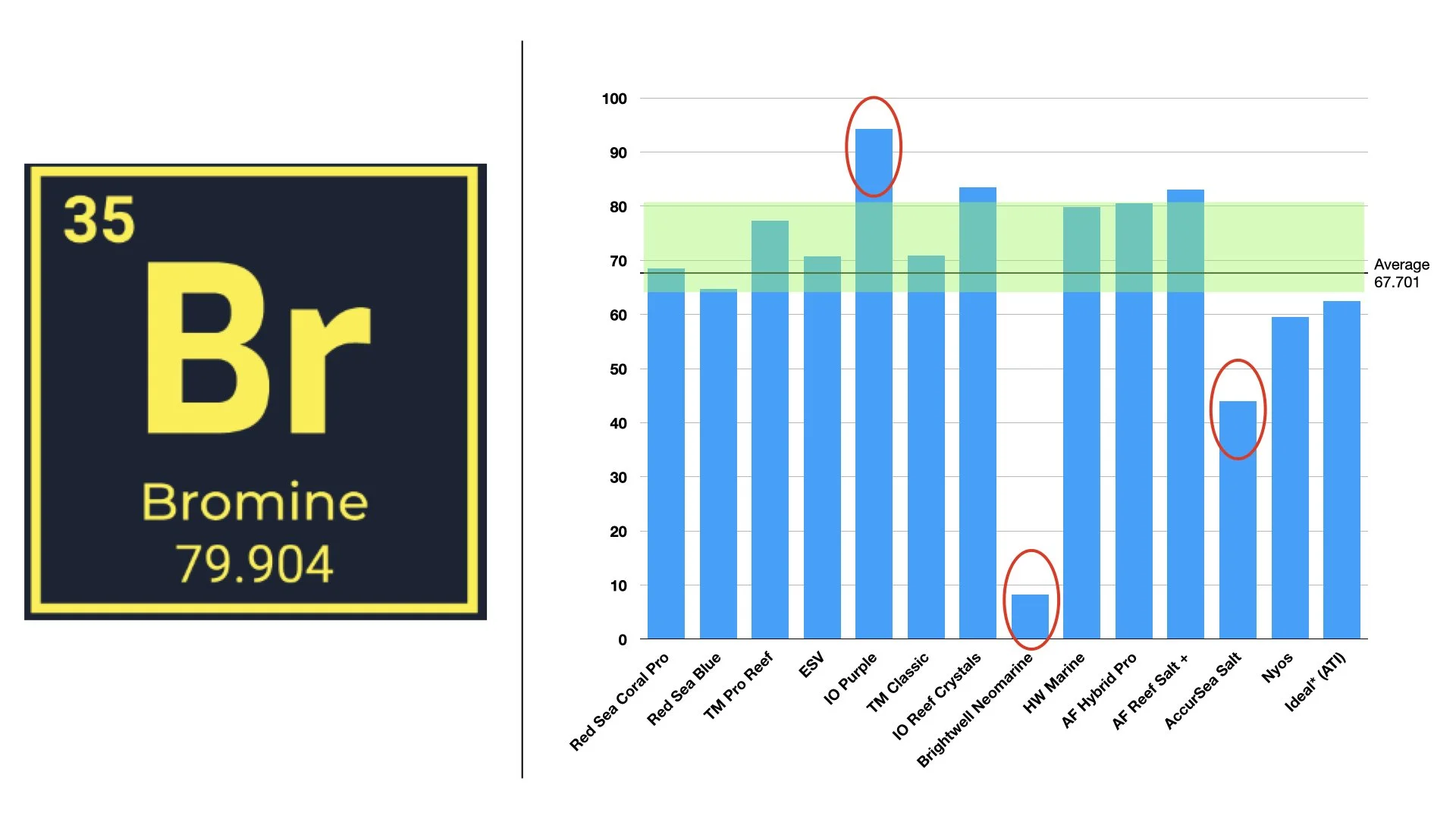
Strontium
Strontium mostly sat in a reasonable range, but a handful of salts tested above typical surface seawater by a significant margin. Some manufacturers intentionally target elevated strontium to support certain coral growth scenarios.
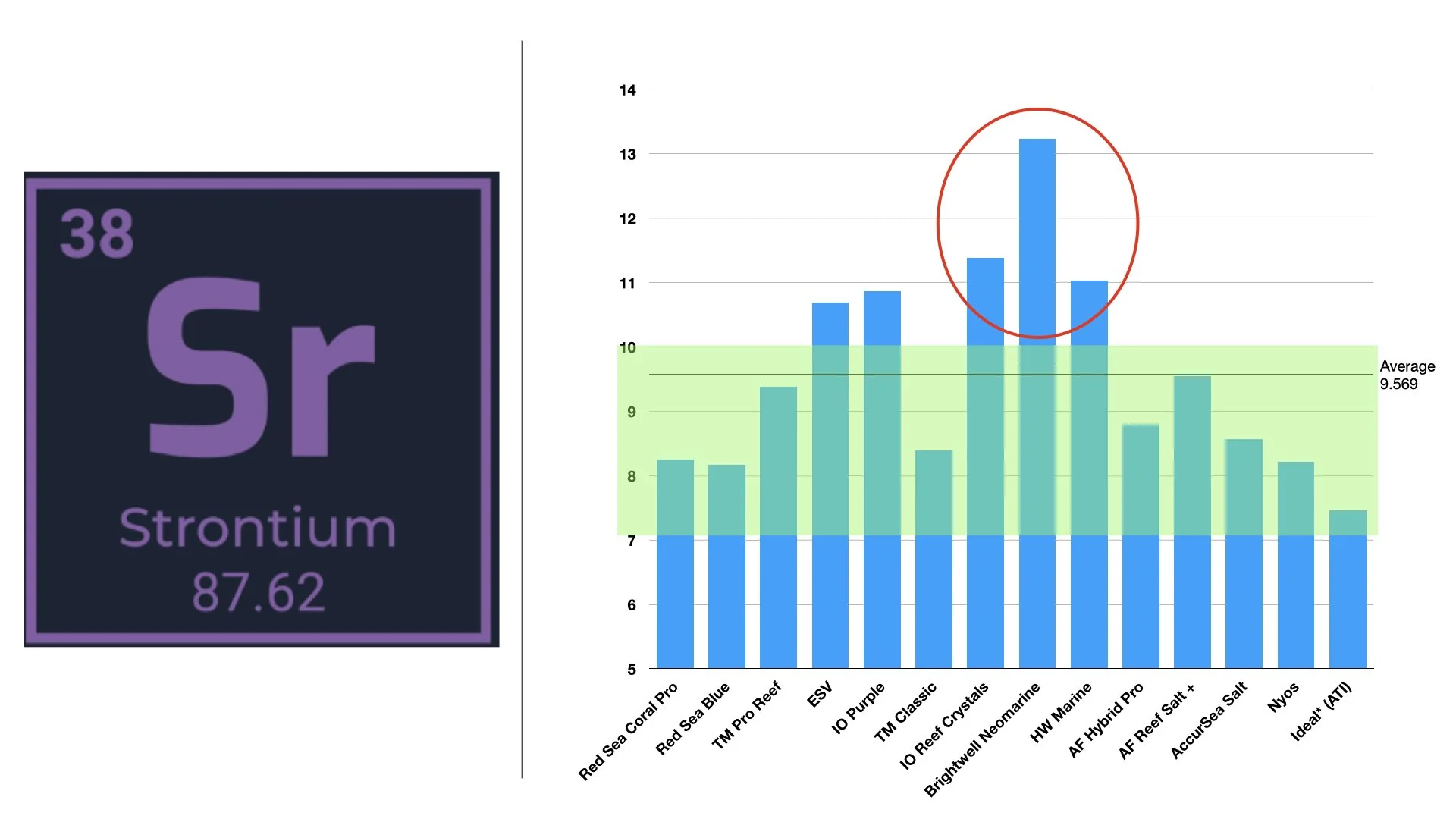
Ultimate Salt Test: Strontium
Fluorine (Fluoride)
Fluoride showed wide variability. Several salts had low fluoride, while a few spiked higher than expected. Fluoride is a controversial trace element. Some reef products add fluoride to influence color in corals, but its biological role is not well established.
Practical takeaway: Fluoride anomalies are best flagged and discussed with manufacturers. If a bucket shows a very high value, consider avoiding it until you understand the source.
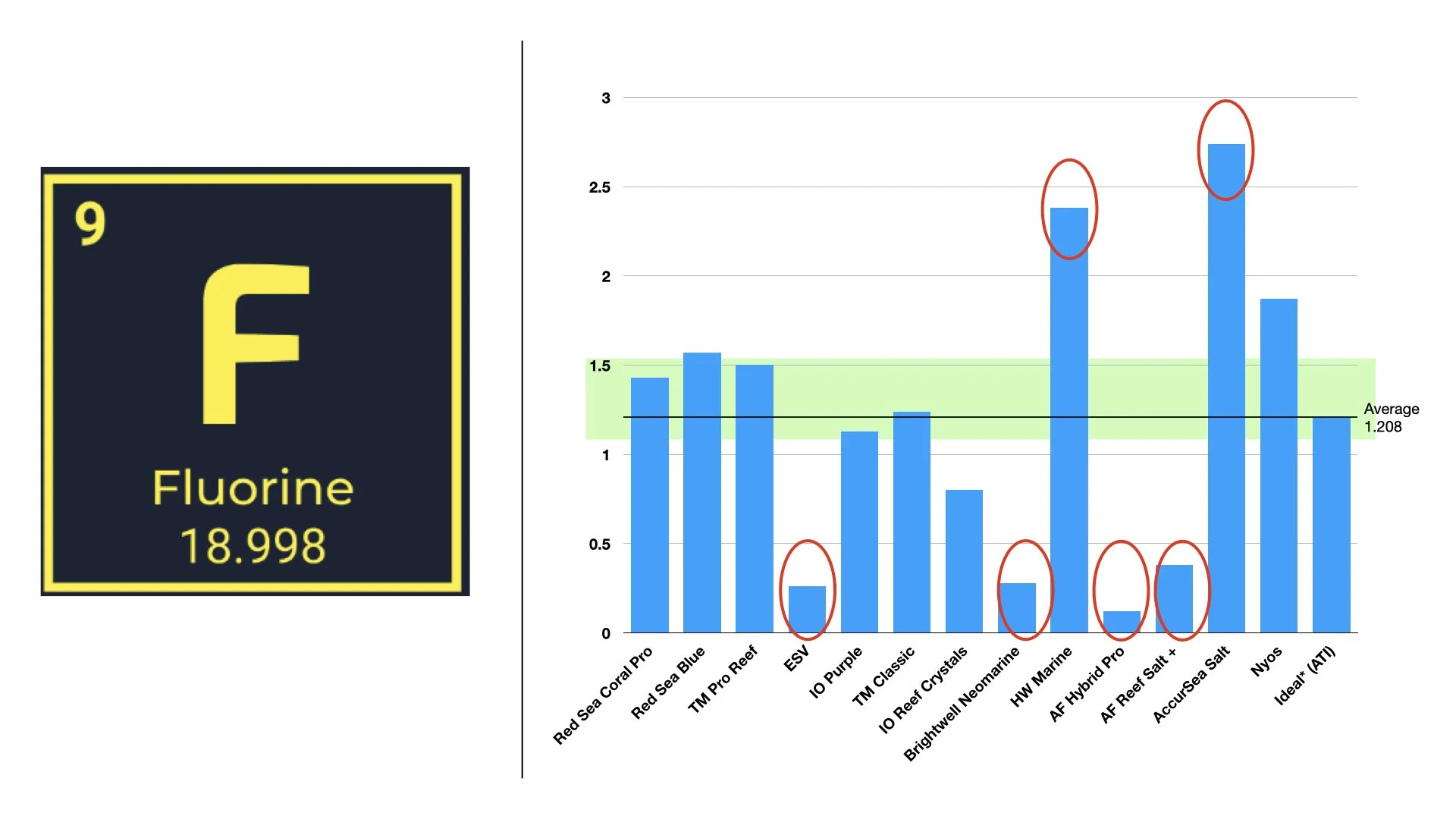
Ultimate Salt Test: Fluorine
Lithium
A number of salts measured higher lithium than expected — often approaching double what natural seawater contains. Lithium is usually an impurity from raw source materials, not a purposeful addition. Many experts consider lithium non-toxic at the levels we measured.
Practical takeaway: Lithium can act as an indicator for other impurities. High lithium often correlates with other unexpected trace elements, so treat it as a red flag to perform a broader check.
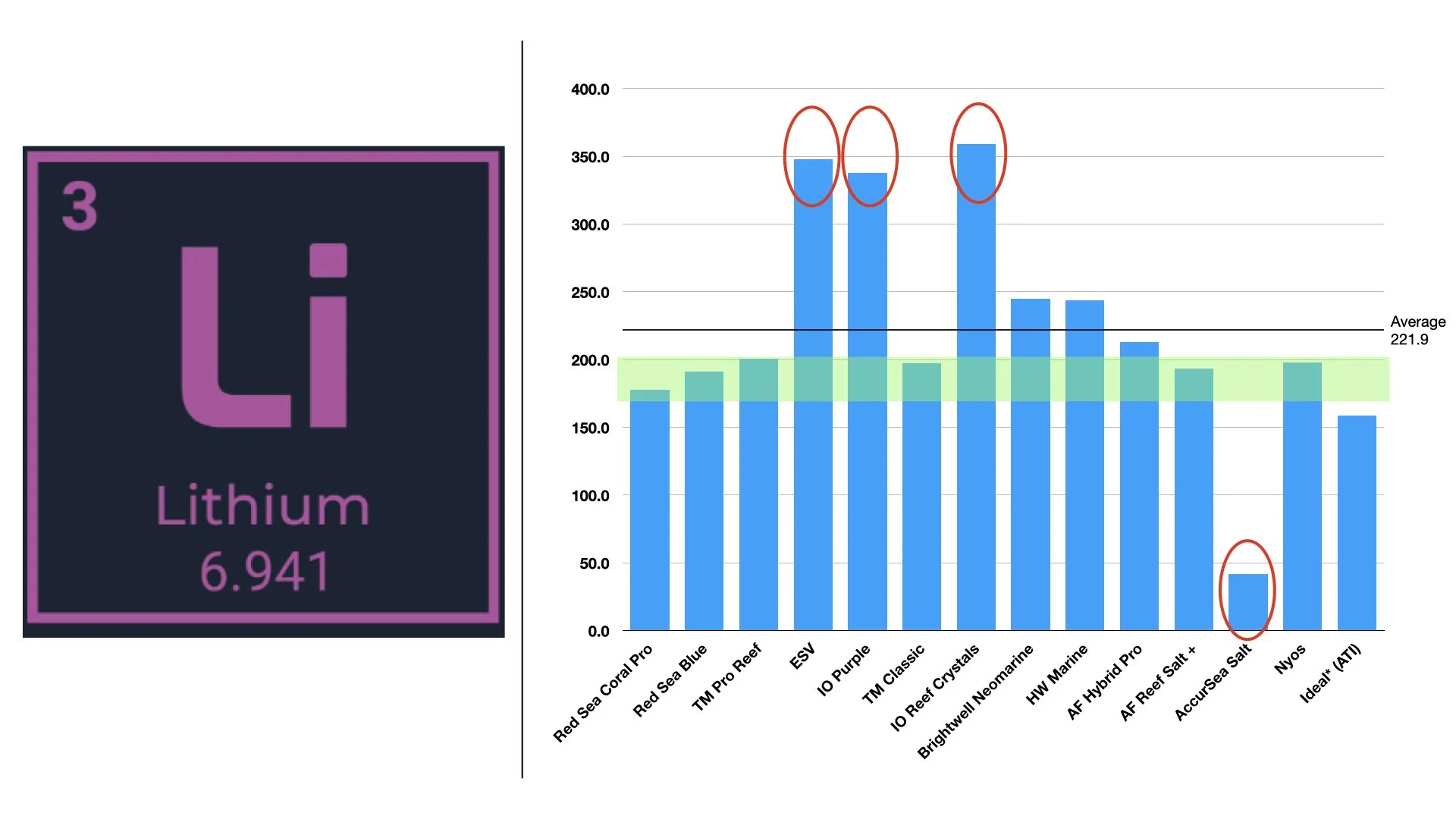
Ultimate Salt Test: Lithium
Silica
Silica levels varied widely. High silica feeds diatoms and certain sponges and may be desirable in specific setups. In contrast, many hobbyists avoid high silica to minimize nuisance diatom blooms.
Practical takeaway: Know the ecology you want. If diatom control is important, prefer salts with lower silica or manage nutrients/filtration accordingly.

Ultimate Salt Test: Silicon
Iodine
Iodine showed substantial variation, with some common salts nearly triple typical seawater values. Iodine is rapidly used in aquaria and often depleted. That is why some dosing regimens include daily iodine maintenance.
Practical takeaway: Expect iodine to change quickly after a water change. If iodine matters to your livestock or coral coloration, monitor and dose intentionally rather than relying on a one-time addition from a water change.

Ultimate Salt Test: Iodine
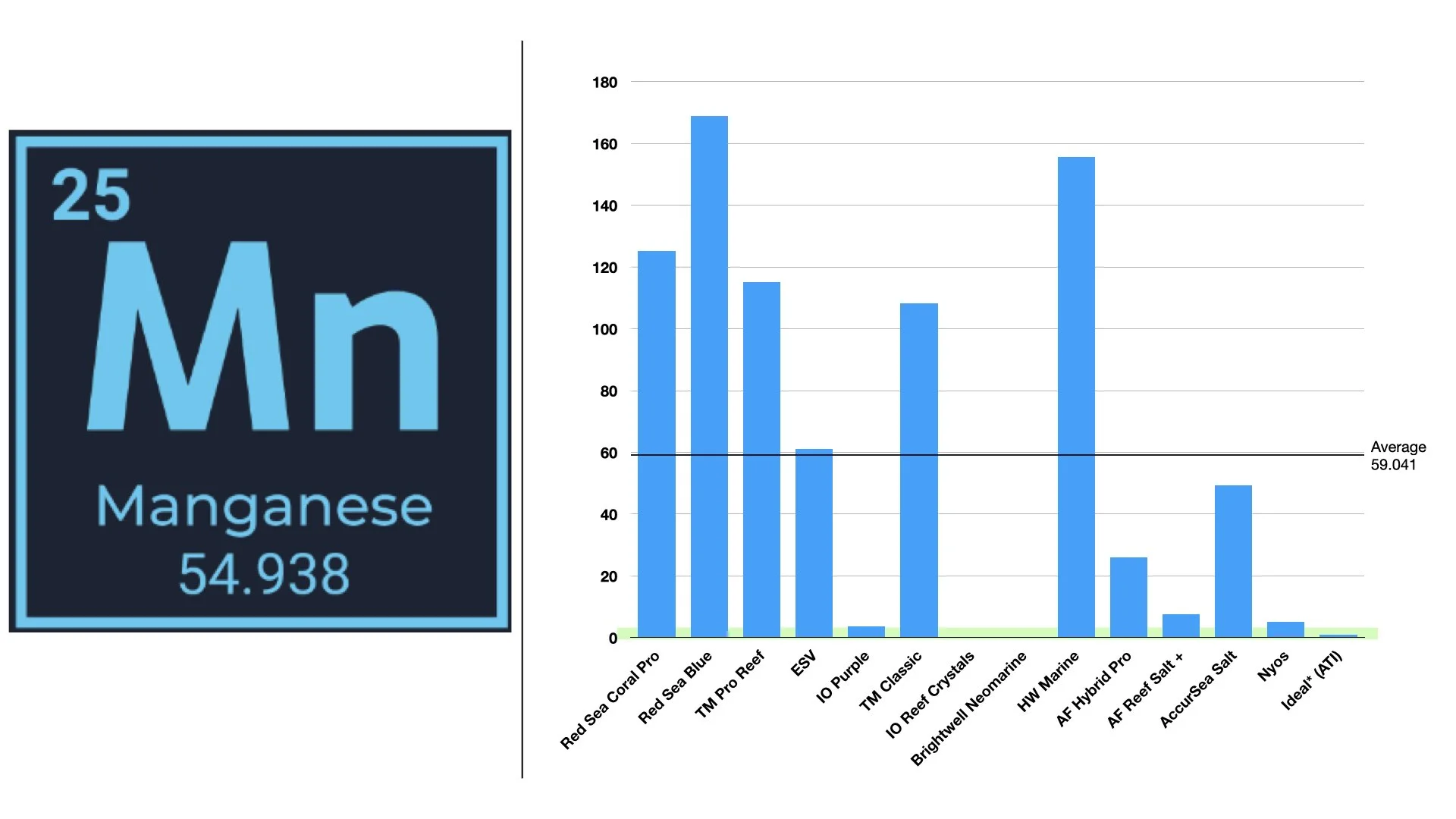
Manganese and Iron
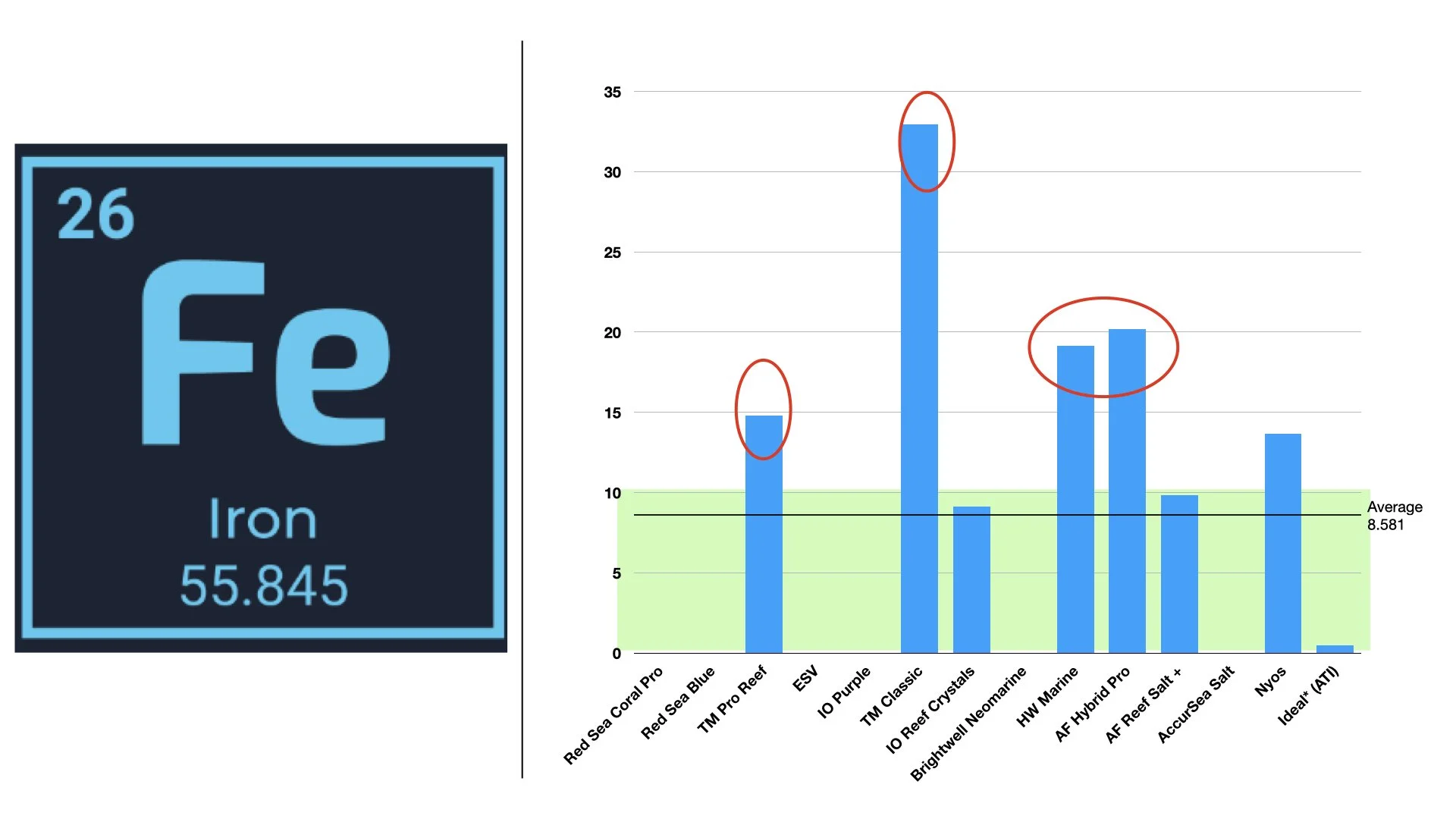
These elements varied a lot. Manganese is rapidly consumed by algae and macroalgae, and elevated manganese can be intentional in salts aimed at supporting growth. Iron was often undetectable because concentrations fall below detection limits. If you plan to grow macroalgae or run a refugium, these trace elements are worth paying attention to.
Copper
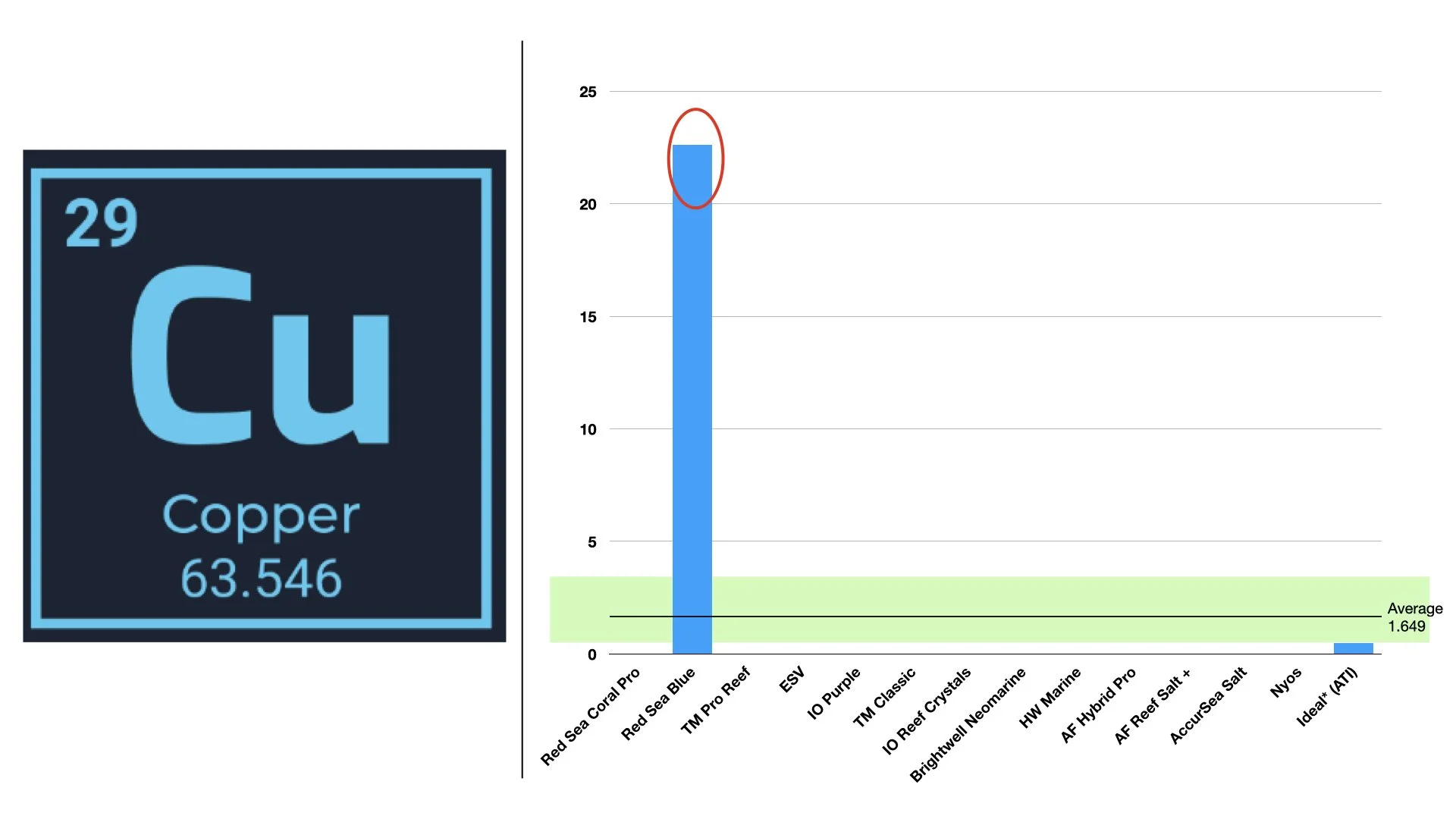
Nearly all salts in the test showed undetectable copper, with one anomalous outlier. Even a single bucket containing unexpected copper is a red flag because copper can be deadly to invertebrates. If something seems off, avoid adding that batch directly to a sensitive system.
While Ryan Thompson’s ATI test results did show copper in the Red Sea Blue Bucket salt, we believe this was an anomaly and not something either of us has seen before.
Ultimate Salt Test: Copper
What The Variations Mean
Differences between salts can stem from raw material sources, manufacturing practices, and mixing consistency. Marine salt mixes are largely sodium chloride with added minerals. If a manufacturer sources lower-cost or less-purified base salts, impurities can show up as elevated lithium, barium, or other oddities.
Batch variability is real. Sometimes a bucket may be “off” because a mixing run was cut short or because a specific raw ingredient lot differed. That can explain why two buckets of the same brand can behave differently.
Method Limitations and Replication
Lab methods matter. ICP-OES is reliable for many elements and has detection limits for very low concentrations. ICP-MS offers higher sensitivity but costs more. Sample storage, shipping, and transit time can change lab results, so timing and handling matter.
Replication is vital. When possible, compare results from multiple labs or run repeated tests on separate buckets. Some anomalies can be lab artifacts or genuine batch issues. If an element shows an extreme value in one test, retest before making big decisions.
Practical Recommendations For Hobbyists
Test the bucket you mix — before you add it to a mature tank, check alkalinity and calcium with hobby kits. They give immediate, actionable data.
Trust home kits for routine checks — alkalinity shifts daily and a hobby test gives real-time info far more relevant than a single lab snapshot.
Use ICP when you need answers — if you suspect chronic issues or see unusual element profiles, professional testing can reveal contaminants or misformulations.
Be cautious with questionable buckets — sudden color, odor, or an off ICP result warrants holding back from adding that water to a sensitive system.
Buy what works for you but stay informed — brand loyalty is fine, but occasional testing helps identify better options or batch issues. When salts go on sale, having a short list of trusted products to stock makes sense.
Watch for storage instructions — some salts explicitly warn against long storage after mixing. Follow manufacturer guidance to avoid precipitation.
Final Thoughts
Salt is not a commodity where one-size-fits-all thinking always applies. Some companies produce remarkably consistent formulations; others show variability or unexpected impurities. The good news is that most salts will not immediately wreck a tank, but the cumulative effects matter — and data helps us make better decisions.
Testing a bucket costs little compared to the investment in livestock and equipment. A simple habit — mix, test, then use — removes guesswork and helps us choose intentionally rather than by habit or packaging.
FAQ:
Should I switch salts because of one anomalous test?
Not necessarily. One anomalous result can indicate a bad bucket or lab artifact. If multiple buckets or independent labs show consistent anomalies, consider switching. For routine use, test a bucket before committing it to an established display.
Are hobby test kits worthless compared to ICP?
Hobby kits are extremely valuable for routine checks like alkalinity, calcium, and magnesium because they provide immediate information. ICP gives a detailed snapshot of many trace elements and impurities that hobby kits cannot detect.
What elements should we be most concerned about?
Elements to watch include alkalinity, calcium, magnesium, potassium, iodine, barium, and copper. Barium and lithium often indicate impurities in raw materials. Unexpected copper can be a reason to pause before using a bucket.
Can lab results vary between labs?
Yes. Different analytical methods (ICP-OES vs ICP-MS) and different labs can produce different results, especially for trace elements near detection limits. Replication across labs or multiple samples improves confidence.
What’s a practical starting step for hobbyists today?
Mix a single bucket, test alkalinity and calcium with your home kits, and keep a record. If something looks off or you have persistent tank issues, consider a targeted ICP test to investigate deeper.
What’s Next on SR Cast?

Acknowledgments
Thank you to Ryan Thompson for sharing his knowledge with the SR community. Thank you to Ryan Batcheller for summarizing the video and making it available to everyone.
Thank you to the Serious Reefs community. Your membership funds the creation of articles and videos like this one.
Support Serious Reefs
Patreon is the best option If you…
Want to discuss with the SR community and ask questions.
Want immediate notifications of every release.
Listen with phone screen off. Patreon app works with phone closed
Want 25% off via annual discounts.
YouTube members is the best option If you…
Watch SR videos on a TV via youtube App
Want to watch videos natively here on seriousreefs.com - (You must use chrome browser and be logged into google account with youtube membership)
Are a YouTube power user.
Tell a friend. Best option if want more (and faster).
If you like what we’re doing, give SR a quick shout-out on your favorite forum, YouTube, Facebook, TikTok, or Instagram. Let your local fish store know SR is helping you explore the hobby and keep it fun. Thanks for the support!
Disclaimer
Full Disclaimer HERE. This is the gist of it.
Content is based on personal experience, not professional advice. Do your research and reef responsibly. Serious Reefs should not be your sole source of information on any topic.
By watching, you agree that Serious Reefs and its creators aren’t liable for how you use this info. Please don’t utilize our information if you are not ok with this.
Serious Reefs has no sponsors, doesn’t accept product or payment for reviews. We do use affiliate links in articles that earn a small commission to support our work. Shop wherever you like, we won’t be offended.

We are about to explore one of the most interesting and most taboo experiments in the reefing hobby. Many people will debate the conclusions, but far fewer have taken the time to produce compelling evidence of their own.